


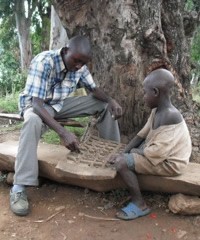

The Bahavu (AKA, Havu) are in the Eastern part of the Democratic Republic of Congo in the region between River Ulindi and the Lake Kivu region (Peuple Havu, 2020). Idjwi island, a beautiful island in the middle of Lake Kivu, is known as the main place the Havu live. Another considerable number Havu live in cities and provinces near Lake Kivu, especially in the territory of Kalehe in the Sud-Kivu province. Several other Havu live in the Congolese diaspora around the world.
The lifestyle of the Havu people is closely tied to their location around Lake Kivu, especially on Idjwi Island, where their relative isolation has allowed them to preserve a strong cultural identity. Life is centered on a combination of farming, fishing, and livestock keeping, but what distinguishes the Havu is the way these daily activities are integrated with deep communal and spiritual patterns. The island itself is not viewed merely as a place of residence, but as a cultural and ancestral homeland that shapes their identity and worldview.
One of the most unique aspects of Havu life is their enduring connection to traditional structures of authority and community. Society remains organized around clans and chiefdoms led by traditional rulers, and these systems continue to influence daily decision-making and social order. At the same time, the people maintain a strong sense of collective responsibility. Work, family life, and major events are carried out in cooperation with the wider community, reinforcing unity and interdependence. Their island setting has also helped preserve a way of life that is both self-sustaining and culturally cohesive, with agriculture, fishing, and local knowledge forming a stable foundation for survival.
Another distinctive feature of Havu lifestyle is the integration of spiritual beliefs with everyday life. Even among those who identify as Christians, traditional beliefs connected to nature and ancestors continue to shape attitudes and practices. The waters of Lake Kivu are often regarded as spiritually significant, and rituals, prayers, or customary practices may accompany activities such as fishing. In this way, there is little separation between the physical and spiritual realms, as both are understood to be part of a unified reality guiding community life.
Entertainment among the Havu is primarily communal rather than individual, and it is deeply woven into social and cultural events. Music and dance are central expressions of joy, identity, and tradition. These performances often include drumming, rhythmic movement, and call-and-response singing, and they are commonly held during weddings, funerals, and other important gatherings. Rather than serving as casual amusement, these activities communicate history, reinforce social bonds, and express shared values.
Storytelling also remains an important form of recreation and cultural preservation. Elders pass down history, moral lessons, and traditional knowledge through oral narratives, ensuring that each generation remains connected to its heritage. In addition, community gatherings themselves serve as a primary form of social enjoyment, where people share food, celebrate milestones, and participate in collective ceremonies. These occasions strengthen relationships and provide opportunities for both celebration and remembrance.
Living in the Democratic Republic of Congo, the Havu have been strongly influenced by Catholicism. There are, however, several Protestant denominations present on Idjwi island where a good number of the Havu life. Despite these influences, there are still Havu who practice ancestral worship and some forms of animism. The beliefs of the Havu will hopefully be transformed with the introduction of the Bible in the Havu language.
Although socio-economic needs abound amongst the Havu, the greatest need remains the knowledge of Christ and access to the Word of God in a language that each Havu understands. As of 2023, there already exists a translation of the Book of Luke (Peuple Havu, 2020), but it still needs broader publication, greater distribution, adoption, and utilization by the Havu speakers.
Beyond that, there are serious needs in medical, educational, and infrastructure areas.
Pray that the entirety of the Word of God would be fully and accurately translated in the Havu language and that the Havu would adopt the translated word and engage with it in faith.
Pray for the Holy Spirit to refresh Havu churches and families with revival fire, empowering them to love and obey the King of kings.
Pray that soon Havu disciples will make more disciples.
Scripture Prayers for the Havu in Congo, Democratic Republic of.
Peuple Havu. (2020, June 12). Havu. https://www.kihavu.com/fr/lire/peuple-havu
Anonymous
| Profile Source: Joshua Project |


